Day 10
Day 10 — She is sitting tight
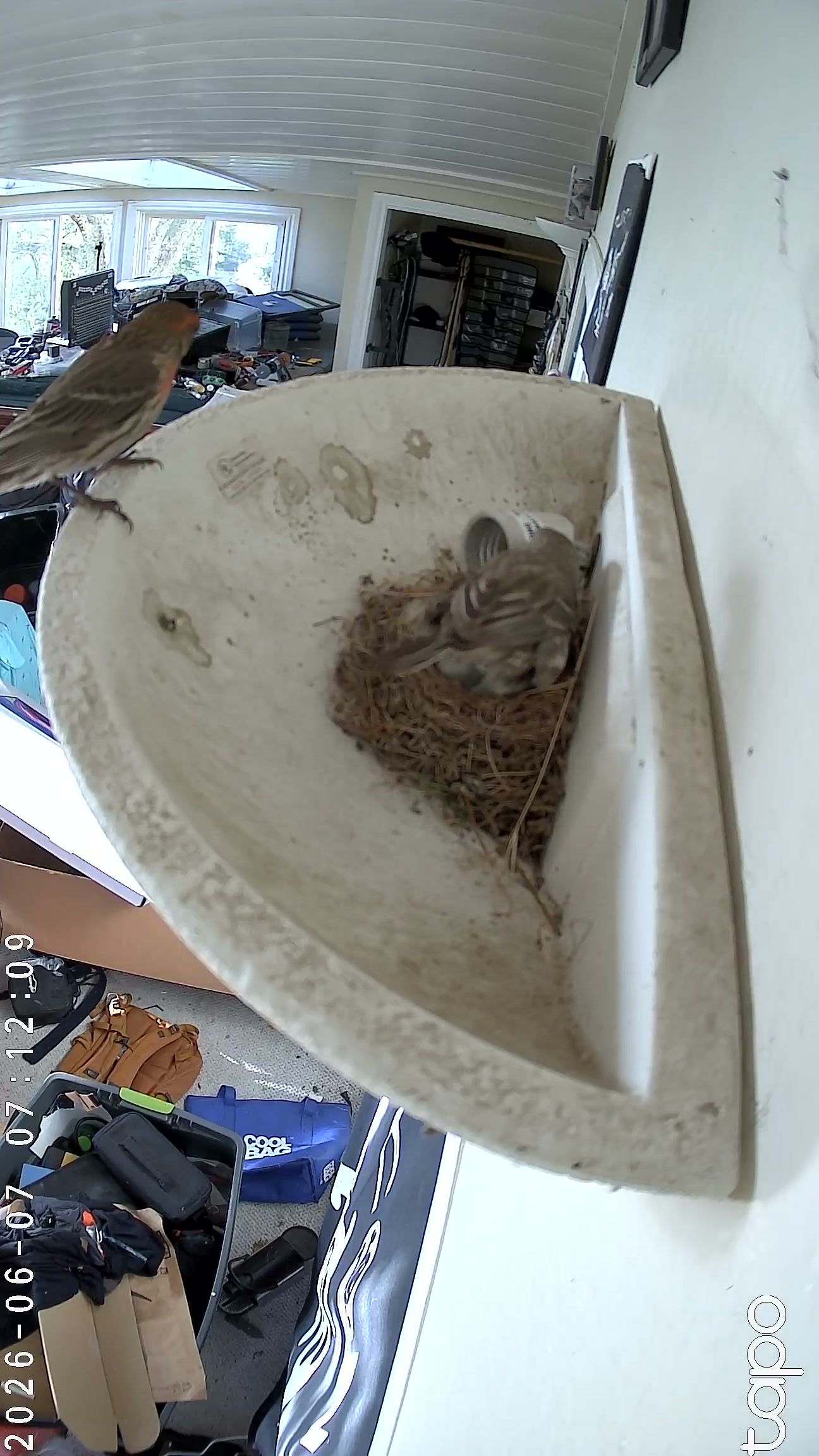
The thing I was watching for, across the back half of last week, was a negative — a dawn frame with the female not in the cup. That would have meant she’d spent the night sitting, gotten up at first light, and the laying phase was still open. For five mornings that’s roughly what the camera showed: a female in and out, a clutch growing one egg per morning, no commitment to stay.
This morning the camera shows the opposite, and the opposite is the milestone.
At 00:02 PT the motion daemon was already firing in the dark — the female on the cup overnight, infrared, a low tucked shape against the back wall of the sconce. She is there at two in the morning. She is there at first light. By the time the day’s captures finish she’s logged 671 of the day’s 682 motion frames with a bird in the cup, and the cup was empty in only 11. That is not the in-and-out signature of a laying female. That is incubation.
The clutch is five. The fifth egg went in yesterday, on Day 9 — the morning she was up at the rim looking out, the last of the one-per-morning sequence that started on June 2. With the clutch complete, she has done what House Finch females do: waited until the end, then committed all at once. This is the trick the whole project was built to film. Because she didn’t start warming egg one until egg five was down, every embryo starts its clock together this morning, and a clutch laid across five mornings will hatch across one or two days instead of five. Delayed onset in, synchronous hatch out.
So today the cycle moves out of laying and into the long quiet middle. Incubation in House Finches runs about twelve to fourteen days. Counting from this morning, that puts the hatch window at June 19 to 21.
A note on the camera, because the rule here is that the camera leads and I’m not going to break it on the milestone post. The male appeared in only three frames today — courtship-feeding visits to the rim, the red head bright in daylight, exactly where the literature puts him during incubation as he keeps the female fed so she can stay down. And the automated classifier flagged a handful of frames this week as possibly showing a chick. They don’t. It is far too early — those are the incubating female misread by a wide-angle frame, and it’s a known weakness of asking a model to call a baby bird out of a dim, mostly-occluded cup. There are no chicks yet. There are five eggs and a female who, as of this morning, is not getting off them.
Watching for the next two weeks: very little, on purpose. A sitting female, a male on the rim, and a countdown. The interesting frames return around June 19.