Field dispatch
The Gap — Five Days the Record Went Dark
The record went dark at 02:58 on the morning of June 26th, and for five days the sconce kept its own counsel. This post is the honest accounting of that gap — because a field journal that papers over its blind spots with invented certainty isn’t a field journal, it’s fiction with charts.
Here is what actually happened, and for once the failure was entirely ours. The birds did nothing wrong. The cameras, in their way, did nothing wrong either. The network underneath them was re-architected — the wireless network the cameras live on was moved to a different segment of the house LAN, the machine that runs this pipeline rebooted onto a new address of its own, and the storage server that receives every clip stopped answering the pipeline’s calls. Each camera came back up (or didn’t) on a network the capture scripts weren’t watching. By the morning of June 27th the daily pipeline was refusing to publish — correctly. It has a rule, learned the hard way in round one: never publish a post with no footage behind it. Five mornings in a row it looked at an empty shelf, wrote a failure note instead of a story, and declined to invent. The one thing the outage never touched was the discipline.
For the data-minded: the main camera’s last clip landed June 26 at 02:58 PT. Its old IP address now belongs to a solar inverter, which is the kind of detail you couldn’t fabricate — somewhere in the DHCP table, the nest camera’s seat was given to the electricity meter. The side camera had already dropped off on June 24. The Reolink has been quiet since early June. Days 30 through 33 of this record have zero frames, from any angle. Nothing in this journal will ever pretend otherwise.
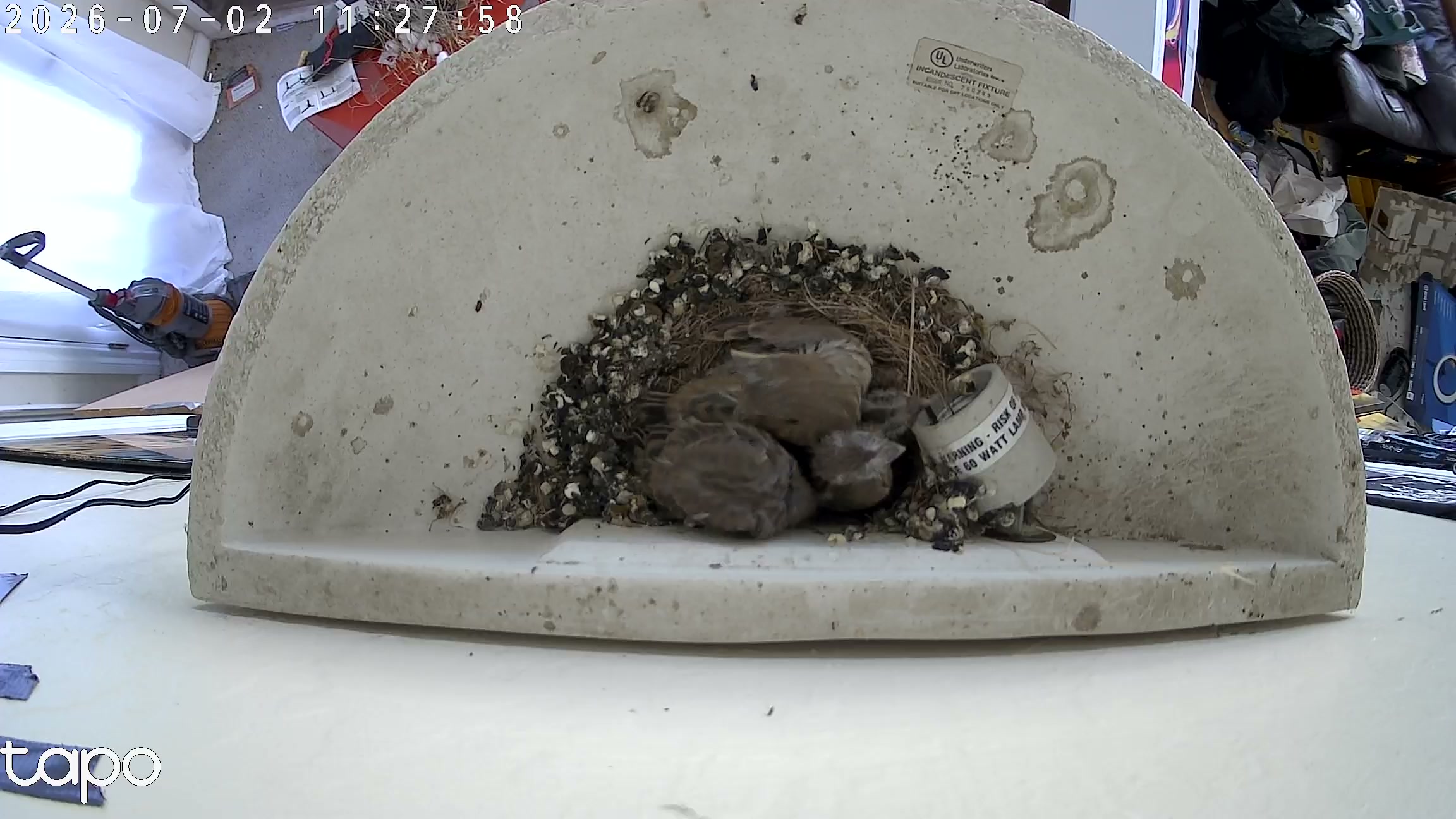
So what do we know about the days we didn’t see? Only what biology and the bookends tell us. Going into the gap, the four surviving nestlings were nine days old, brooded nearly around the clock, the female a lid on the cup. Coming out of it — this afternoon, July 1, with capture restored — the camera returned this:
Well-feathered nestlings, still in the nest, crowding a cup they have visibly outgrown. At least two are clearly distinguishable in this frame, likely a third beneath them; the tangle of feathers makes an exact count dishonest, so I won’t offer one. What matters is the headline: the fledge was not missed. These birds are fourteen days from hatch, square in the middle of the House Finch fledging window, and they are still here. The gap swallowed five days of brooding footage — the quiet, repetitive middle of nestling life — and spared the finale.
One small honesty note on the image itself: the timestamp burned into the corner reads July 2. The camera keeps its own eccentric clock, about twelve hours ahead of reality, and always has. The pipeline names every file by the true Pacific time it was captured; the OSD is decoration. We document our instruments’ quirks here rather than cropping them out.
Capture is running again as of this evening — every two minutes, to a new storage home, from the one camera that found its way back onto the new network. The main camera and the Reolink still need a human hand at the wall socket, and until then the record leans on a single angle. But it leans on something real. Watching resumes; the finale is still filmable; and if the next post in this journal is the empty-cup morning, it will be because the camera saw it, not because the narrative demanded it.